
The working journal / Inside the product
Making room for the duck: the rules behind a packing puzzle
How Waddle We Pack separates artwork from occupied cells, validates a layout, and checks whether a puzzle can be solved.
A suitcase puzzle looks like a collection of travel objects, but the rules operate on occupied cells. A boot, a souvenir, and a duck can each have a different silhouette while the game still needs an exact answer to a simple question: does this placement fit?
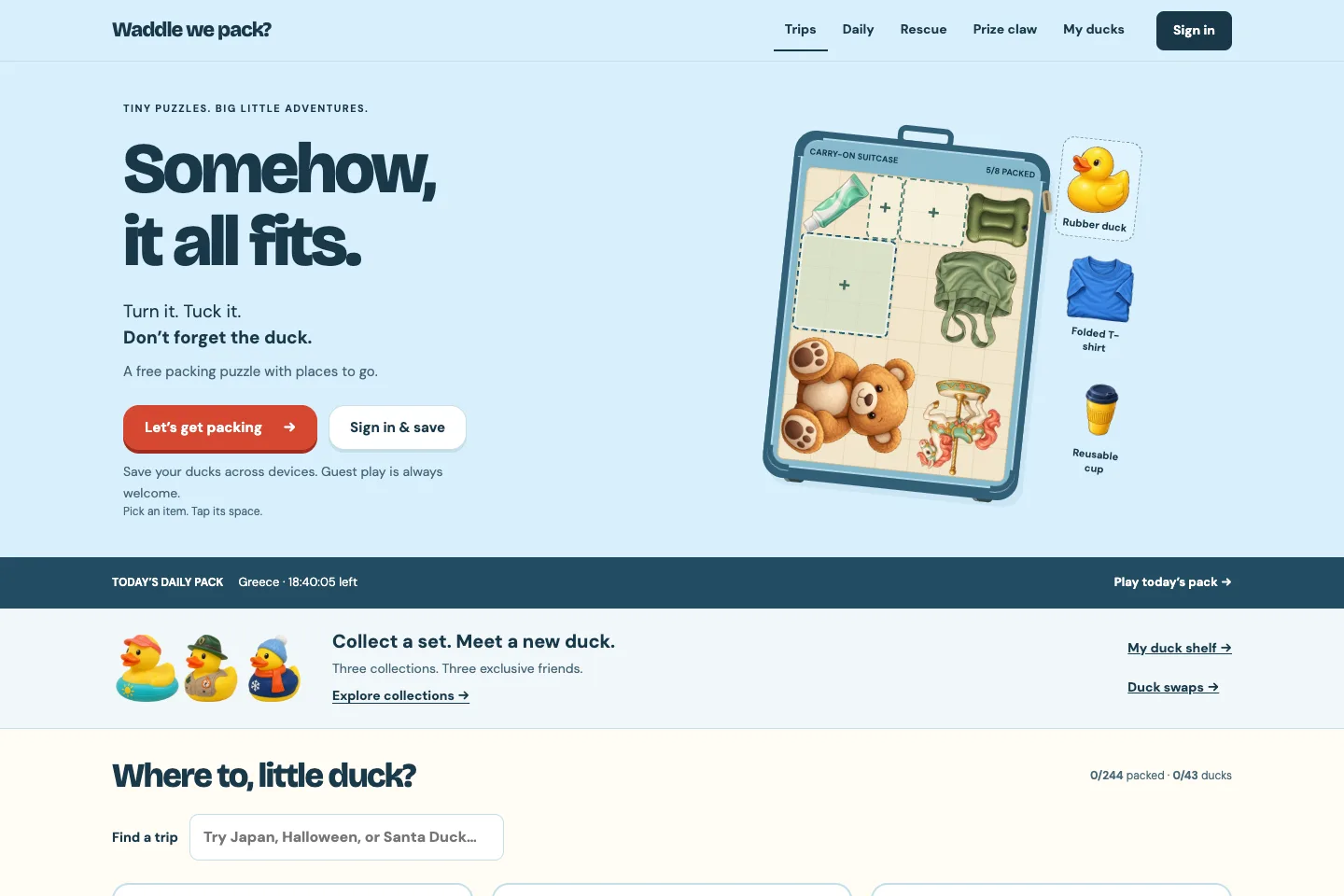
Waddle We Pack keeps the puzzle rules separate from the artwork. That lets the game change destinations and objects while checking movement, overlap, and completion through the same engine. This article explains those mechanics using a small illustrative layout.
Give each object an exact footprint
Represent an object as a set of grid coordinates relative to its origin. A simple L shape might occupy (0,0), (0,1), and (1,1). Its decorative image can include shading and detail, but collision checks use those three cells. A large transparent image rectangle should not accidentally become the collision boundary.
In the illustration below, A is the L-shaped object, B and C fill the remaining spaces, and D marks the reserved duck footprint. This is a fully packed teaching example. The actual engine checks whether all required objects and rules are satisfied; it does not require every suitcase cell to be filled.
| Row | Column 1 | Column 2 | Column 3 | Column 4 |
|---|---|---|---|---|
| 1 | A | B | B | D |
| 2 | A | A | B | D |
| 3 | C | C | C | D |
This grid explains occupancy only. It does not assert that these invented pieces belong to the game catalog.
Rotate the rules and the artwork together
The engine rotates cell coordinates in quarter turns and shifts the result back to a zero-based origin. This normalization lets a rotated item be placed using the same grid position fields as an unrotated one. Four quarter turns return the footprint to its original orientation.
A visual rotation needs to stay aligned with that footprint. If the illustration appears to leave a gap that the rules call occupied, players cannot make a reliable decision. For similar games, test asymmetric pieces first: an L shape reveals orientation mistakes more clearly than a square.
Separate a legal move from a completed puzzle
A candidate placement must belong to the puzzle, use integer coordinates and a supported rotation, remain within the board, and avoid blocked or already occupied cells. Moving an existing object excludes that object's old placement from the collision set, so it does not collide with itself.
Completion adds more checks: each required object must be present exactly once, and every relationship rule must hold. The engine supports touch and apart relationships. Touching means sharing a cell edge; a diagonal corner is not enough. A nearly complete arrangement may still need one object moved to satisfy that rule.
- Bounds: every occupied cell stays inside the suitcase.
- Collision: no object covers blocked space or another object.
- Identity: an item cannot be counted twice.
- Relationships: any required edge contact or separation holds.
Know what a solver can and cannot prove
Puzzle validation checks a supplied solution against the same arrangement rules. The search solver can also try legal positions and rotations. It skips duplicate orientations for symmetric objects and chooses the remaining object with the fewest available placements, reducing unnecessary branches.
Search has a work budget. If the budget is exhausted, the engine reports that separately from proving the current arrangement impossible. This distinction matters: "we did not finish checking" is not the same as "there is no solution." A product should not punish a player for a limit in its helper.
Let the theme clarify the goal
The travel duck gives the final space a recognizable purpose. Destination artwork and collectibles provide variety around the shared spatial problem. Rescue mode changes the starting situation: a bag already contains objects, and the player needs to make room for the missing passenger.
For a designer, the next question is whether that setting makes the rules easier to read. Can someone identify the selected object, understand a rejected move, and see the difference between empty and blocked space? A successful solution should feel earned by the player's reasoning. Clear silhouettes, consistent rotations, and understandable feedback support that experience.
Sources and further reading
- Play Waddle We Pack
The public packing game. Engine behavior described here was checked against the deployed implementation on September 21, 2026.
- Waddle We Pack overview
Trips, rescue puzzles, collections, and the intended experience.
Share this article
Continue the conversation
A question, a different experience, or an idea for the next article? Send Jason a private response.