
The working journal / Implementation & operations
Configuration is part of the application, not an afterthought
Configuration changes can alter behavior without changing a screen. Lessons from Shared Configuration Manager and a documented website release on scope, validation, deployment, and recovery.
Imagine changing a setting. The application still starts, the deployment finishes, and the screens look the same. Hours later, someone discovers that an updated resource is not reaching users, a request is timing out, or a background operation is running differently.
Configuration can change the behavior people receive without changing a screen. That is why settings deserve the same care as application code.
The useful question is not whether every setting belongs in source code. It is whether the team can explain what changed, where it applies, and how to recover if it was wrong.
Why configuration needs an operating process
Jason's Shared Configuration Manager is published for OutSystems 11. Its documented scope includes custom web.config configuration, LifeTime deployment integration, queues, and audit reporting. The accompanying Medium article is related reading for that work.
That combination is useful context. Editing a value and applying it safely are different responsibilities. A clearer editing interface helps, but it does not replace knowing which applications are affected, who may deploy the change, and what record will remain afterward.
The following example comes from a separate implementation: the Blutek Media website's September 21, 2026 performance release. It used nginx and a release script, not Shared Configuration Manager. The technologies differ; the questions about scope and recovery still apply.
One cache setting, two different needs
The website's original asset policy gave the relevant static files a seven-day cache lifetime. During the performance work, content-addressed files received a longer lifetime. Mutable filenames kept the existing policy.
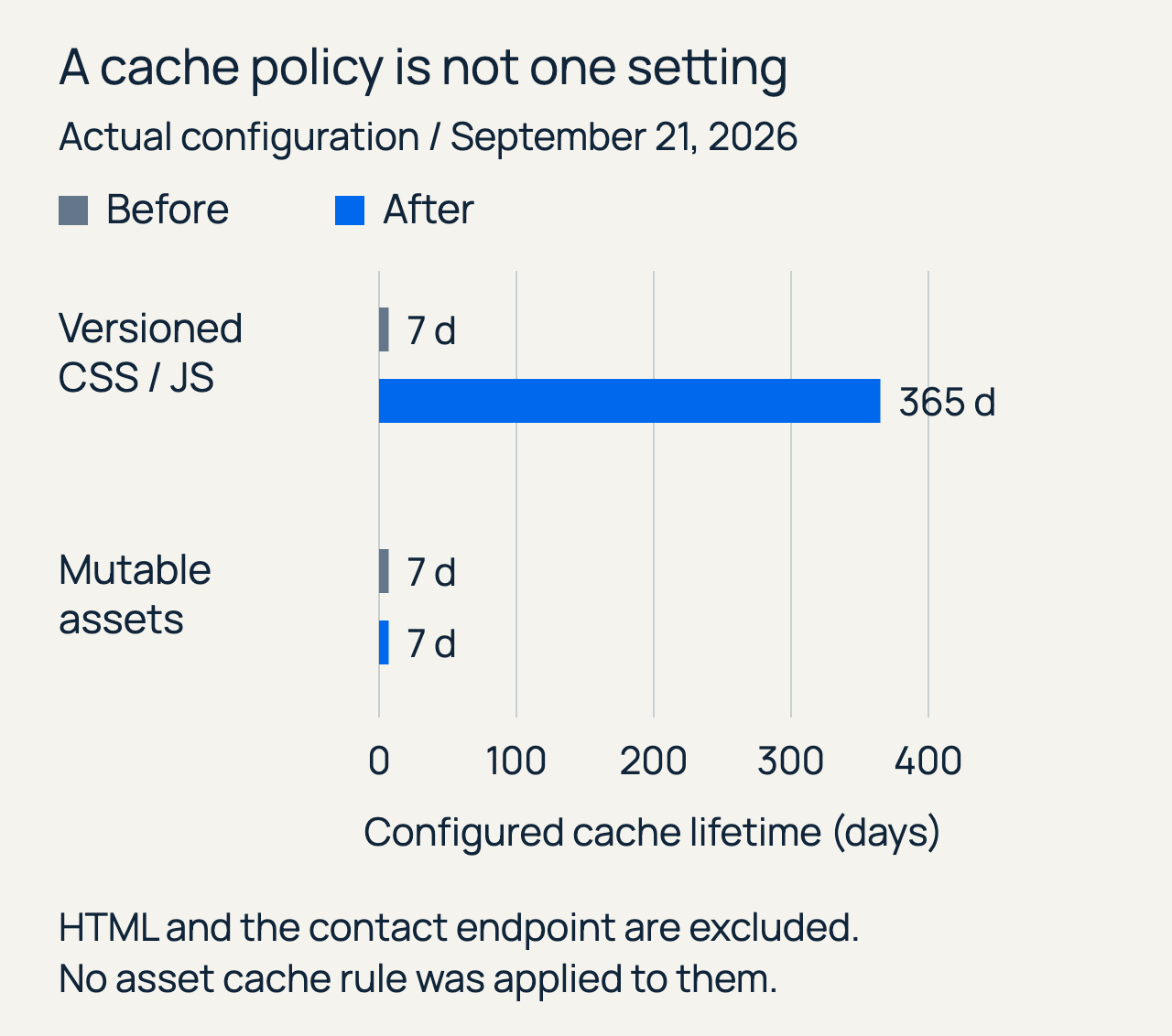
This was not simply a decision to make every cache last longer. Versioned assets and page HTML serve different purposes. A file whose name changes when its contents change can be reused aggressively. A page needs to lead the reader to the current content and asset names.
That distinction is why the chart excludes HTML and the contact endpoint. They were not assigned the asset cache policy. Showing them as zero-day bars would misleadingly turn the absence of that rule into a measured cache lifetime.
Review the scope before the value
Before discussing whether 365 days is suitable, ask which requests the rule matches. Does it cover only generated assets? Could it also match a response that contains current user data? Does another rule run first?
For the website release, the long-lived rule matched content-addressed CSS, JavaScript, and the new hashed image paths. The broader asset rule retained seven days. Existing security headers were preserved, and the contact endpoint remained separate.
In another application, the equivalent review might concern which module receives a setting, which environment it targets, or which deployment plan applies it. A correct value in the wrong scope is still a configuration error.
Validate more than the syntax
A parser can establish that configuration is syntactically acceptable. It cannot establish that the application still behaves as intended.
For this release, validation had several layers. File manifests checked what was transferred and installed. A comparison checked that the server configuration had not changed since preparation. nginx validated the proposed configuration before reload. After deployment, live responses were inspected for the expected protocol, compression, cache policy, and security headers.
Each check answered a different question. None was a substitute for the others. A valid configuration pointing at the wrong release would not become correct merely because the syntax check passed.
Make recovery specific to the failure
The release script retained the prior configuration and the previous release target. If nginx validation failed, it restored the original configuration before ending the release attempt. If reload failed after the release switch, its recovery branch restored both the prior target and configuration and attempted the reload again.
That describes the implemented recovery paths. It does not claim we forced each failure in production or measured a recovery-time objective.
This distinction matters when writing operational documentation. "Rollback is supported" can mean several different things. Does it restore files, configuration, data, or all three? What happens to work already completed under the new settings? Which failures can still require manual intervention?
In this particular case, rolling back server settings would not instantly recall a resource already cached by a visitor. The asset naming strategy and cache policy must account for that limitation in advance.
Keep a change record someone else can use
A record does not need to be elaborate to be useful. For a small deployment, a reviewed configuration difference, a release identifier, validation results, and the prior target may be enough to explain what happened.
For a shared environment, the team may need a more formal view of applications, permissions, queued work, and deployment history. That is where a component such as Shared Configuration Manager becomes relevant to the discussion. Its deployment integration, queues, and audit reporting address those administrative responsibilities.
Do not confuse an audit record with a place to copy every sensitive value. Record which approved credential reference or configuration version was used where appropriate, rather than reproducing secrets in deployment notes or screenshots.
A small review before the next setting change
| Question | What a useful answer contains |
|---|---|
| Where does it apply? | Named environment, application, module, or request scope |
| What behavior changes? | A concrete effect a tester can observe |
| How is it checked? | Syntax validation plus relevant application checks |
| What is the previous state? | A recoverable version, not someone's recollection |
| What cannot be undone? | Cached responses, completed actions, or other lasting effects |
These are review prompts, not a claim that one process fits every platform. A one-person application should not inherit the administrative burden of a large shared environment without a reason.
Configuration deserves attention because it participates in the application. Treating it that way makes the next deployment easier to inspect and the next unexpected result easier to investigate.
The companion performance case study describes what the website measurements showed. This article focuses on how the changes were scoped, applied, and checked, rather than attributing the result to one setting.
Share this article
Continue the conversation
A question, a different experience, or an idea for the next article? Send Jason a private response.